
Wind Regions Explained
Understand Your Wind Region & Engineering Requirements
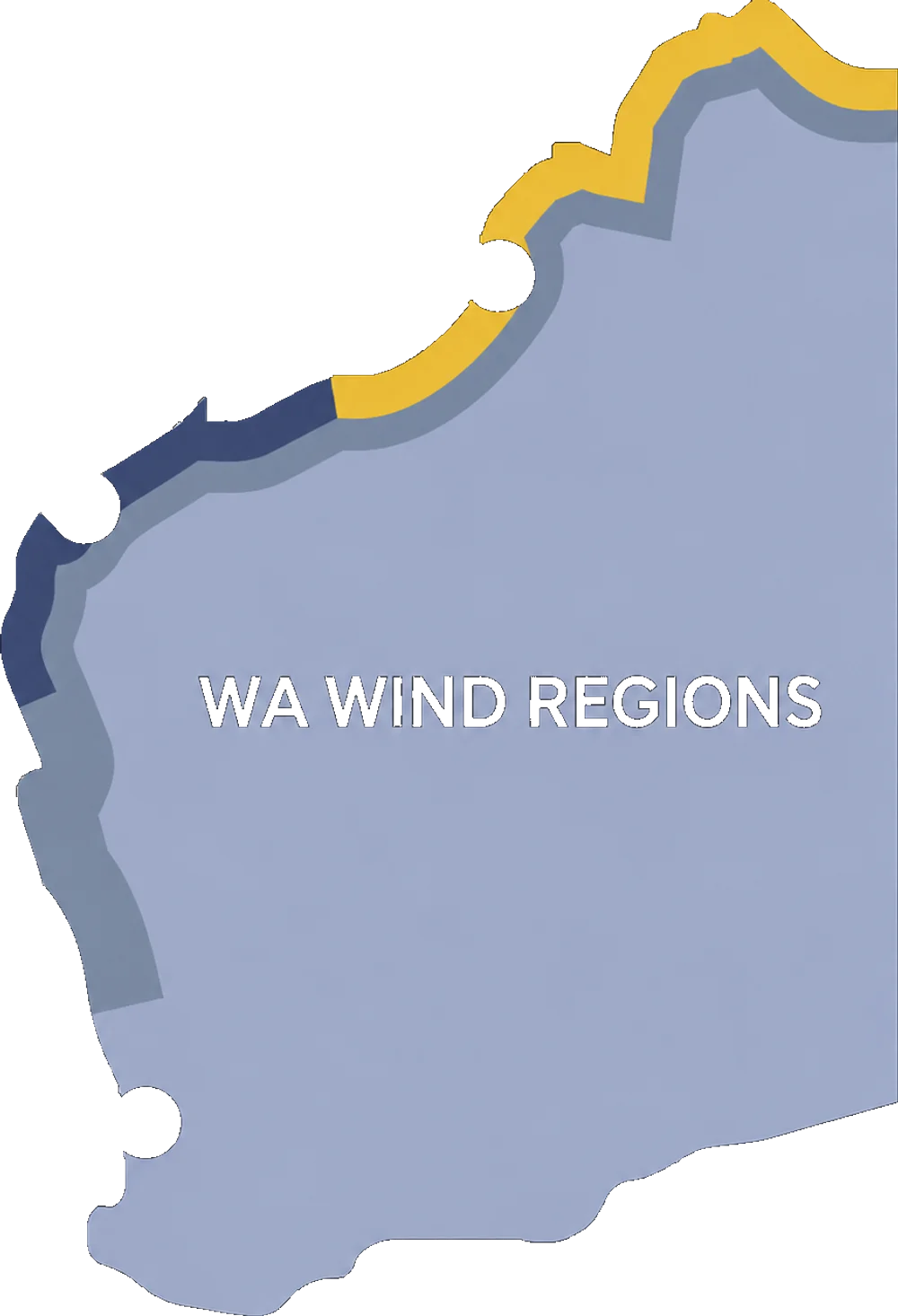
Western Australia has some of the most varied wind conditions in the country. From sheltered suburban blocks in Perth through to exposed coastal, rural and northern regions, wind region and site conditions inform project design.
Workshop Shed Estimator
Get an instant shed kit estimate.
- 1 Shed
- 2 Size
- 3 Location
- 4 Estimate
Enter your shed size
Your postcode helps adjust the price for your WA wind region. It does not confirm final engineering, certification or approval.
Your Shed Estimate
—
Incl GST
Repayment Example
—
36-month calculation example
Free 1-Hour Workshop
Buy the kit. We'll show you how your shed kit goes together before you start.
LEARN ABOUT THE FREE WORKSHOPThis estimate is a guide. It includes 1 roller door, 1 PA door and an 11° roof pitch. Add your postcode for the right WA wind region. Engineering included; shire costs and delivery are quoted separately. The weekly figure is a 36-month example. It does not confirm an available finance product or term.
Quick Answer
A wind region is the geographic zone (Region A, B, C or D) that informs the design wind speed considered in shed engineering. Much of WA's south-west sits in the lower non-cyclonic Region A, while exposed coastal and northern areas move into the higher Region B and cyclonic C and D zones. Your wind region — combined with your terrain category — informs the steel sizes, bracing, footings and fixings considered for your shed kit, so it should be confirmed before manufacturing.
For the full picture, read the complete Wind Regions WA guide or the shed engineering guide.
WHY YOUR WIND REGION MATTERS
Understanding your wind region is important because it affects the following — and project engineering can account for Western Australian conditions.
Key Facts
- Australia is divided into four wind regions — A, B, C and D — under the wind-loading standard, with higher letters carrying higher design wind speeds.
- Much of WA's south-west, including many Perth metro suburbs, sits in the lower non-cyclonic Region A.
- Exposed coastal areas and large parts of northern WA move into the higher Region B and cyclonic Region C and D zones.
- Wind region works together with your terrain category (TC1-TC4), which measures how exposed or sheltered your specific block is.
- Your wind region and terrain category directly affect steel sections, bracing, footings and fixings — and therefore the indicative cost of a kit.
- Wind region maps are a guide only; your exact address, shielding and topography all feed into the final engineering.
- Shed documentation requirements depend on the site — see the shed engineering guide for detail.
WHAT ARE WIND REGIONS?
Wind regions are areas classified by expected wind speeds. They are used by engineers to determine how strong a structure needs to be. A patio or shed built in a low wind area may require different steel sections and connections compared with a structure built in a high wind or cyclonic region. That is why wind region matters before the kit specification is finalised.
WHY WIND REGIONS MATTER
Safety
Project engineering considers wind conditions at the site.
Compliance
Engineering documentation may be required for council or building approval.
Structural Performance
Correct engineering helps ensure the right steel, bracing, fixings and footings are used.
Long-Term Durability
A properly engineered structure is more likely to perform well over time.
WA WIND REGIONS
Western Australia may include several wind region classifications depending on location.
Wind Region A
Generally applies to many non-cyclonic areas of Western Australia. Common examples may include many Perth metro and southern WA locations.
Wind Region B
Applies to areas with higher wind requirements. Some regional and northern areas may fall into this classification.
Wind Region C
Cyclonic wind region. Requires stronger engineering, heavier structural components and more detailed assessment.
Wind Region D
Extreme cyclonic wind region. Requires specialised engineering and is generally associated with highly exposed cyclonic locations.
IMPORTANT NOTE
Wind region maps are a guide only. Your actual engineering requirements may also depend on the following — always confirm requirements before ordering.
TERRAIN CATEGORY ALSO MATTERS
Wind region is only one part of engineering. Terrain category considers how exposed your property is to wind.
Terrain Category 1
Very open exposed terrain
Examples may include open coastal or flat exposed land.
Terrain Category 2
Open terrain with scattered obstructions
Common in rural and semi-rural areas.
Terrain Category 2.5
Intermediate terrain
Between open and suburban conditions. Often used for developing or partially protected areas.
Terrain Category 3
Suburban or built-up areas
More shielding. Common in established residential suburbs.
HOW IT AFFECTS PATIO DESIGN
For patios, wind region may affect:
This Applies To
HOW IT AFFECTS SHED DESIGN
For sheds, wind region may affect:
This Applies To
WHY HIGHER WIND REGIONS CAN COST MORE
Higher wind areas may require the following. This is why two structures that look similar may have different prices depending on location.
HOW TO FIND YOUR WIND REGION
Provide Your Suburb Or Postcode
Your general location helps identify the likely wind region.
Confirm Site Conditions
Factors such as exposure, terrain and surrounding buildings may affect engineering.
Check Engineering Requirements
Our team can help identify what engineering may be required for your project.
Design The Correct Kit
Once requirements are known, your patio or shed kit can be designed accordingly.
PROJECT ENGINEERING FOR WA CONDITIONS
Patio & Shed Kits WA supplies patio and shed systems designed with engineering requirements in mind. Depending on the project, engineering documentation may include:
WHY CHOOSE PATIO & SHED KITS WA
Family Owned Since 1999
Trusted by Western Australians for over 25 years.
HIA Award Winning Company
Recognised for quality, workmanship and customer service.
Engineer-Certified Documentation
Designed for Western Australian conditions.
Factory Direct
No unnecessary middleman markup.
Z Purlins As Standard For Sheds
Structural Z purlins supplied as standard for solid shed framing.
Free Installation Workshops
Helping customers build with confidence.
Visit Our Factory
See the quality before you buy at 3 Oliver Street, Bellevue WA.
Delivered Across WA
Metro, regional and remote delivery available.
Key Takeaways
- Wind region (A-D) sets the base design wind speed; terrain category (TC1-TC4) measures how exposed your block is — engineers use both together.
- Most of the WA south-west is non-cyclonic Region A, while coastal and northern WA can be Region B, C or D, with cyclonic areas needing heavier engineering.
- Higher wind regions can mean larger steel, more bracing, heavier connections and bigger footings, which can raise the indicative price of an otherwise similar kit.
- Maps are only a guide — confirm the wind region for your exact address before ordering. The complete Wind Regions WA guide explains the full picture.
- For structural detail and certification, see the shed engineering guide, and the glossary for plain-English definitions.
FREQUENTLY ASKED QUESTIONS
READY TO CHECK YOUR PROJECT?
Get a patio or shed designed for your location and WA conditions.
Patio & Shed Kits WA
Family Owned Since 1999 • HIA Award Winning Company
Engineer-Certified Documentation Available • Factory Direct • Built For WA