
Wind Regions WA
How Wind Affects Patios & Sheds in Western Australia
Western Australia is a very large state, and different areas can have different wind conditions.
Some places have lower winds, while other areas can have very strong winds and storms. Because of this, patios and sheds need to be designed to suit the wind conditions where they will be built.
This guide explains wind regions and terrain categories in a simple way. You will learn how they can affect the steel, bracing, footings and engineering needed for your patio or shed.
Quick Answer
Find Your Wind Region
Enter your WA postcode to instantly see your AS 4055 wind region and what it means for your patio or shed engineering.
WA Wind Region Calculator
Enter your postcode to find your wind region.
Western Australian postcodes run from 6000 to 6999.
This is a guide only. Project engineering confirms your wind region and terrain category. Terrain category tells the engineer how open or sheltered your site is.
Your wind region will appear here
Enter a 4-digit WA postcode. You will see your AS 4055 wind region and what it means for your build.
What Are Wind Regions?
A wind region is a geographic zone used to determine a building's design wind loads. Australia is divided into four regions — A, B, C and D — under the national wind-loading standard, with each step up representing progressively stronger expected winds. Regions C and D are cyclonic, while Regions A and B are non-cyclonic.
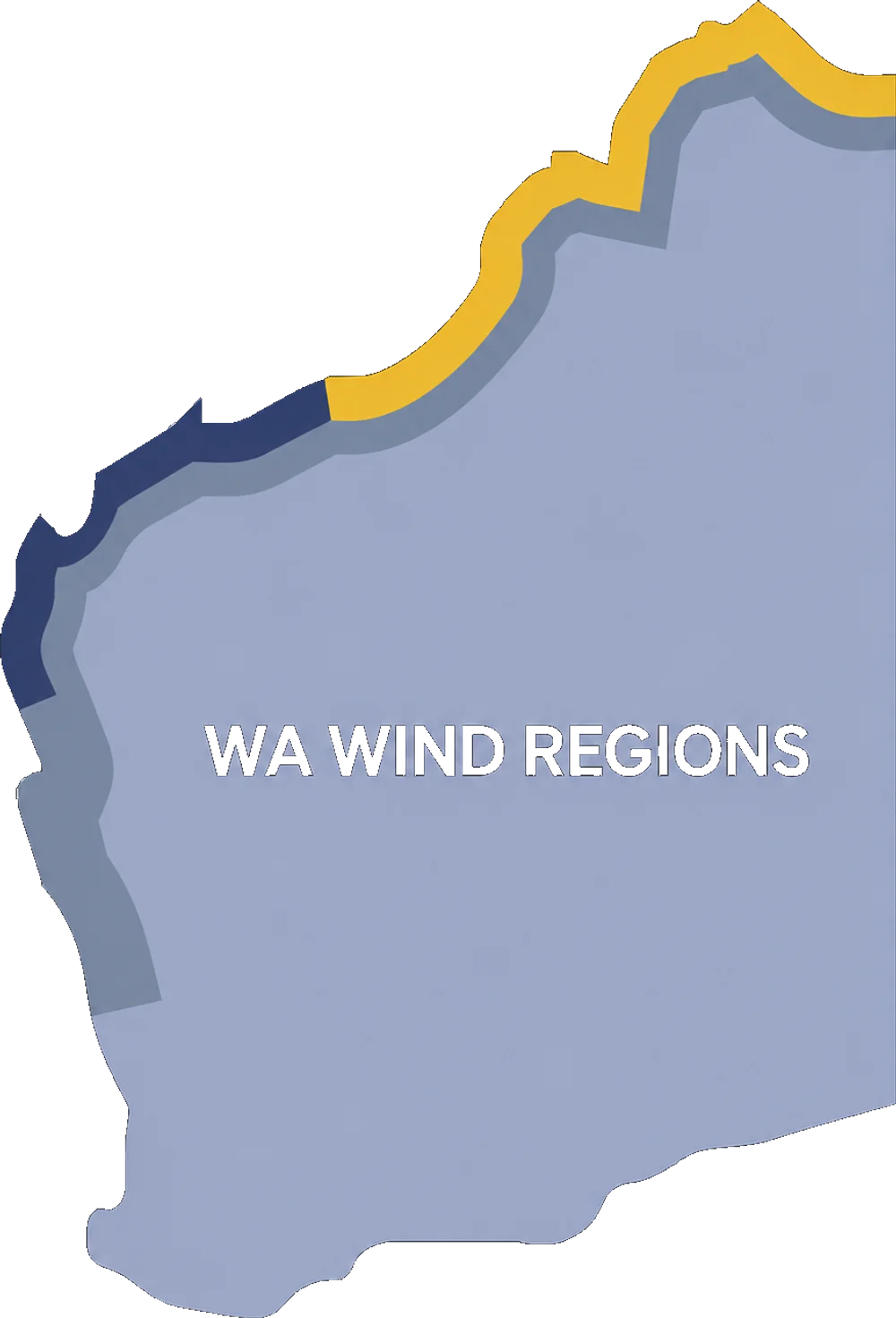
Because Western Australia is so large, it does not sit in a single region. The cooler, more sheltered south-west generally falls in the lower-wind zones, while the coast and the tropical north-west — where cyclones occur — sit in the higher and cyclonic zones. Two otherwise identical structures can therefore need very different engineering depending purely on where in WA they are built.
Wind region is never considered in isolation. It is paired with a site's terrain category — a measure of how exposed or sheltered the block is — to calculate the actual wind loads acting on a patio or shed.
Wind Regions Explained (A, B, C, D)
The table below describes each region in general terms. Specific design wind speeds are determined by the engineering for your project — the descriptions here are a guide only.
| Region | Typical WA Areas | Conditions | Design Impact |
|---|---|---|---|
| Region A | Much of the inland and southern south-west, including many Perth metro suburbs | Lowest design wind speeds of the four regions; non-cyclonic | Standard structural steel and bracing for typical sheltered sites |
| Region B | Broad coastal strips and transitional areas outside the cyclonic zone | Higher non-cyclonic winds than Region A | Heavier sections, additional bracing and larger footings often required |
| Region C | Northern coastal WA within the tropical cyclone zone | Cyclonic, with strong sustained winds and gusts | Substantially upgraded steel, connections, tie-downs and footings |
| Region D | Parts of the far north-west WA coast, the most severe cyclonic zone | Most extreme cyclonic conditions in Australia | Maximum engineering: the heaviest sections, fixings and footings |
Region boundaries and the area examples above are indicative only. Confirm the wind region that applies to your site through the project engineering.
Terrain Categories
Terrain category describes the roughness of the ground around your structure. The more open and exposed a site is, the higher the wind loads; the more it is sheltered by surrounding buildings and trees, the lower the loads. Engineers combine your terrain category with your wind region to size the structure correctly.
TC1 — Very Exposed
Open water, flat open coastal land or open plains with few or no obstructions. The most exposed sites experience the highest wind loads.
TC2 — Open
Open terrain with grassland and scattered, well-spaced obstructions such as isolated trees or buildings — common on rural and acreage blocks.
TC2.5 — Suburban Edge
A transitional category used where a site sits between open and built-up surroundings, such as newer or fringe suburban developments.
TC3 — Suburban / Sheltered
Built-up areas with numerous closely spaced houses, fences and trees that shelter the site and reduce wind loads on the structure.
How Wind Affects Your Patio
Wind can have a big effect on a patio. When wind blows over and under the roof, it can try to lift the patio upwards.
In areas with stronger winds, the patio may need stronger structural elements. This may mean stronger posts, beams and rafters, extra bracing and larger concrete footings.
Large patios and raised (flyover) patios can be affected by wind even more because they have a bigger roof area.
This means the same patio may need different engineering in different parts of Western Australia. A patio in a windy coastal area may need stronger materials than the same patio in a sheltered suburb, which can also affect the price.
How Wind Affects Your Shed
Wind can have a big effect on a shed. Strong winds push against the walls, pull on the roof and can even get inside through open doors.
In areas with stronger winds, sheds need to be built stronger. This may mean heavier steel, extra bracing, stronger purlins and girts, larger footings and stronger connections to keep the shed secure.
Tall sheds and sheds with large open spaces inside usually need even stronger engineering because they carry more wind load.
That is why it is important for a shed to be designed for the wind conditions and terrain at your property. Site engineering determines the structural requirements for Western Australian weather.
Why Engineering Is Important
Engineers work out how strong a patio or shed needs to be for your property.
They look at things like the wind in your area, how open your block is, and the size and height of the structure. They then specify the steel, bracing, connections and footings for the design loads.
Engineer certification shows that your patio or shed has been designed for the conditions at your site. These documents are often needed when applying for a building permit.
Engineering also gives you confidence that your patio or shed is built to handle Western Australian weather conditions.
Disclaimer: Wind region, terrain category and approval requirements vary by local government area and project. Region and area examples on this page are general guidance only — always confirm the requirements for your specific site with your local government or a registered building surveyor, and rely on the engineering prepared for your project.
Key Facts
- Australia is split into wind regions (A, B, C and D) under the national wind-loading standard, and Western Australia spans several of them.
- Much of the lower south-west — including many Perth suburbs — sits in the lowest-wind Region A, while coastal and northern WA move into Region B, C and cyclonic D.
- Your terrain category (how sheltered the site is) is assessed alongside your wind region to calculate design loads.
- Higher wind regions and more exposed sites generally require heavier steel sections, extra bracing, stronger connections and larger footings.
- The same patio or shed design can be engineered differently from one location to another purely because of wind region and terrain.
- Wind region is a major driver of both the engineering required and the indicative cost of a patio or shed.
Key Takeaways
- WA is not a single wind zone — region varies widely from the south-west through to the cyclonic north-west.
- Wind region + terrain category together determine the loads your structure must resist.
- Heavier conditions mean upgraded steel, fixings and footings — see our shed engineering guide.
- Always have a structure engineered for the actual site, not a generic assumption.
- Confirm your wind region and any approval requirements with your local government or a registered building surveyor.
Frequently Asked Questions
Get A Patio Or Shed Engineered For Your Wind Region
Tell us about your site and we'll help you with a kit engineered for your wind region and terrain category — built for Western Australian conditions. Pricing is indicative only and depends on your specific requirements.