
Welded vs Riveted C-Channel Trusses
Fewer Joints, More Rigidity, A Cleaner Finish
Many patio kits use lightweight C-channel trusses joined together with rivets, while our Elite Patio Range uses fully welded trusses. Both can be engineered to meet the relevant standards — compare them on joints, rigidity, appearance and spans to see why welded construction is commonly chosen for premium patios.
Patio Kit Estimator
Get an instant patio kit estimate.
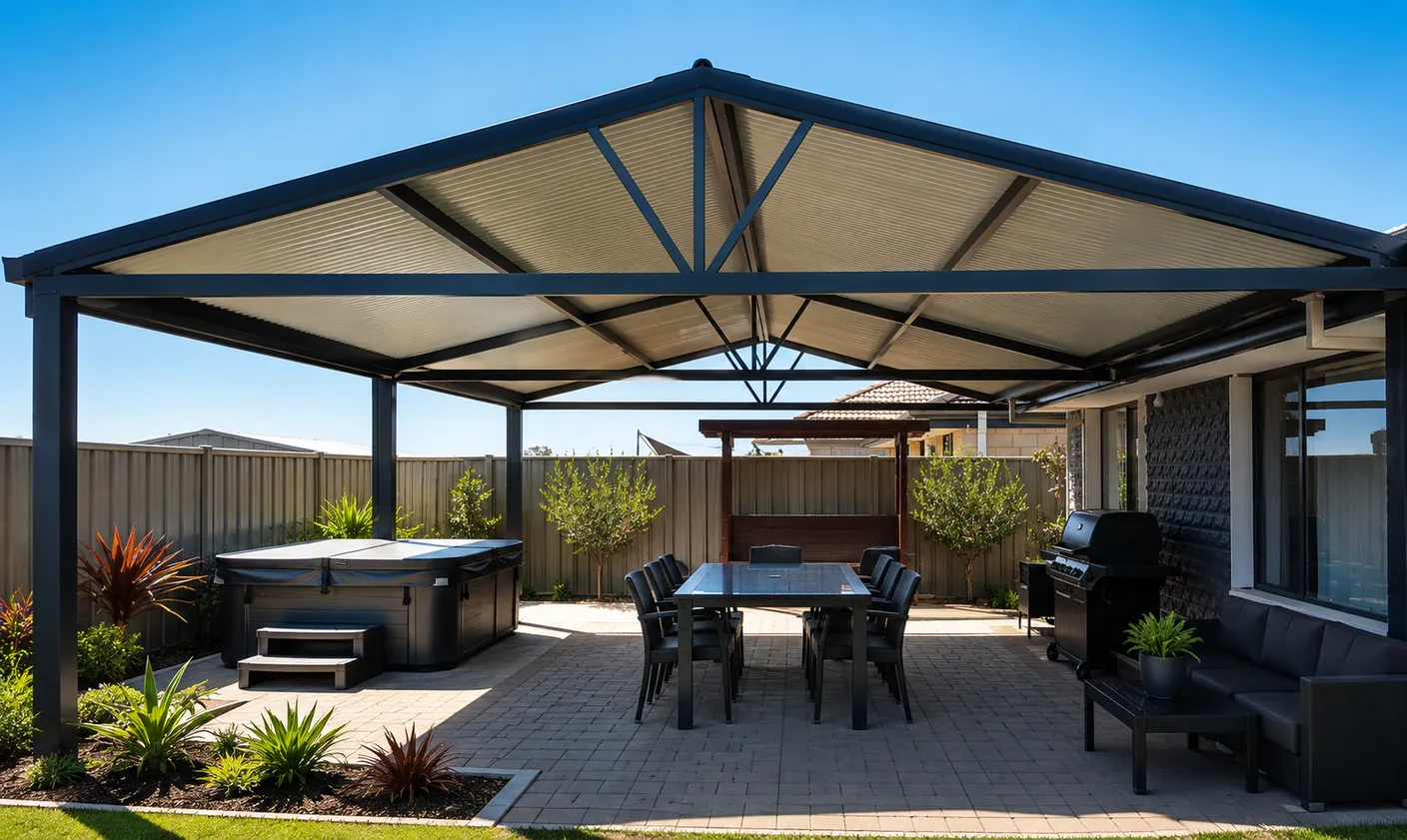
Traditional corrugated steel patio roofing.
From
$35 pw*
Total Price
$4,760
Incl GST
This estimate is a guide. It uses your chosen size, design and Corrugated roofing. Standard estimates do not include optional engineering unless we say so. If needed, engineering is priced on its own in every region. Your final price also depends on colour, roofing and site needs. The weekly figure is a 36-month example. It does not confirm an available finance product or term.
Free 1-Hour Workshop
Buy the kit. We'll show you how your patio kit goes together before you start.
LEARN ABOUT THE FREE WORKSHOPQuick Answer
Welded vs Riveted Trusses At A Glance
| Feature | Welded Truss | Riveted C-Channel Truss |
|---|---|---|
| Construction | Fabricated as a single welded assembly | Sections joined with rivets or fasteners |
| Joints & connections | Fewer mechanical joints along the truss | More connection points along the truss |
| Rigidity | Generally more rigid, with less flex under load | Relies on fastened joints to transfer load |
| Appearance | Clean lines, minimal visible fixings | Visible join plates and fixing points |
| Spans | Commonly engineered for larger, open spans | Widely used; often more economical |
| Where we use it | Our Elite Patio Range | Common across many lower-cost kits |
Each Truss Explained
Welded Truss
Premium constructionFabricated as a single welded assembly for our Elite Patio Range.
Pros
- Fewer mechanical joints across the truss
- Generally more rigid, with less flex under load
- Clean lines and minimal visible fixings
- Commonly engineered for larger, more open spans
Trade-offs
- Typically a premium option vs basic sectional trusses
- Fabricated to spec in the workshop, not field-assembled
Best For
Premium patios, exposed underside areas and wider spans where rigidity and finish matter.
Riveted C-Channel Truss
Common, economicalLighter steel sections joined with rivets or mechanical fasteners.
Pros
- Widely used across many patio kits
- Can reduce manufacturing cost
- Lightweight steel sections
Trade-offs
- More joints and connection points along the truss
- Visible join plates and fixing points
Best For
Budget-focused builds where the underside finish is less of a priority.
Fewer Connection Points
A welded truss is fabricated as a single structural assembly. Because the members are welded together during manufacture, it generally has fewer mechanical joints than a truss assembled from sections using rivets or screws. Fewer connections can mean reduced movement within the truss, greater rigidity and cleaner load transfer through the frame.
Improved Structural Rigidity
When wind loads are applied to a patio roof, forces are transferred through the truss system. Because a fully welded truss behaves as one integrated structure, it can help distribute loads more effectively across the frame, which generally results in a more rigid roof with less flex under load. Both welded and riveted trusses are capable of being engineered for your wind region, but the welded construction is a key reason it is favoured for premium systems.
Cleaner Appearance
Riveted trusses often have visible join plates, overlapping sections and multiple fixing points. Welded trusses generally provide cleaner lines, minimal visible connections and a more premium finish. This is particularly important when the underside of the patio remains visible from entertaining areas.
Suited To Larger Spans
Welded trusses are commonly used in larger and more demanding structures because they can be engineered to accommodate greater loads and wider spans. That can allow larger entertaining areas, wider open spaces and fewer internal supports — though the span achievable always depends on your site, wind region and design. Check what suits your space with our patio calculator.
Precision Manufactured
Our welded trusses for the Elite Patio Range are fabricated under controlled workshop conditions to engineering specifications before being supplied as part of your patio kit. This supports consistent quality, accurate dimensions, an improved fit during installation and reliable structural performance.
The Patio & Shed Kits WA Difference
Many competitors use sectional C-channel trusses joined together with rivets to reduce manufacturing cost. Our Elite Patio Range features fully welded trusses, engineered for Western Australian conditions, for a more rigid and more premium finished structure. Both approaches can be engineered to meet the relevant standards — but when you want fewer joints, greater rigidity and a cleaner underside, welded construction is the choice we recommend.
Key Takeaways
- Welded trusses are fabricated as a single assembly, so they generally have fewer joints and more rigidity than riveted C-channel trusses.
- Fewer visible fixings give welded trusses a cleaner, more premium underside — ideal where the patio is on show.
- Welded trusses are commonly used in premium systems and can be engineered for larger, more open spans.
- Our Elite Patio Range uses fully welded trusses; site-specific patio engineering is available as an optional extra if required.
Frequently Asked Questions
Build On A More Rigid, Cleaner Frame
Preview colours on a photo of your own home, get instant pricing, or talk to our WA team about the welded trusses on our Elite Patio Range.